Author: Karin Thalberg

Internship Opportunities 2027 – Climate Change Leadership research unit, Uppsala University

Would you like to work on issues relating to environmental governance together with competent colleagues in an international environment? Welcome to Uppsala University.  

The Department of Earth Sciences is Sweden’s largest and most diverse department of its kind, with a unique breadth of expertise and around 308 staff members. We have interdisciplinary research and education programmes in several areas. The research unit for Climate Change Leadership (CCL) belongs to the programme ‘Natural Resources and Sustainable Development’. CCL studies strategies to address various environmental problems. The research is transdisciplinary and concerns both natural and social systems, as well as their interactions at the interface between science, policy, and society.  

CCL also hosts the International Office (IO) of the Earth System Governance Project (ESGP). ESGP is a global research network that aims to advance knowledge at the interface between global environmental change and governance. The network connects and mobilises scholars from the social sciences, humanities and interdisciplinary fields researching at local and global scales. The IO is the focal point for management, administration, communication, and network development within the global ESGP network. In September 2027, the IO will host the 2027 Uppsala ESG Conference, expected to gather 500 researchers from various countries. See further: https://www.earthsystemgovernance.org/annual-conferences/  

CCL seeks two motivated and enthusiastic interns to support the research unit and the IO. Please note that you are required to be enrolled in an internship course within a Master’s degree programme at a university in Sweden to apply.


Two internship positions

  • Location: Uppsala, Sweden. Duration: 6 months, full-time 
  • Start date: 18 January 2027 
  • Compensation: Unpaid (required to be enrolled in an internship course at a university in Sweden) 

The two interns will work jointly on the tasks in the indicative list below, adapted to upcoming needs and reflecting the interns’ strengths and evolving interests. 

Key responsibilities 

Support to the International Office’s activities: 

  • Assisting with organizing the global conference; as well as other meetings, webinars, and events; 
  • Supporting the preparation of the 2026 ESG Annual Report; 
  • Supporting communication and other outreach activities, including newsletters, website updates, and social media; 
  • Writing popular scientific texts on key events and topics in environmental governance;  
  • Maintaining and updating databases and contact lists; 
  • Supporting other day-to-day activities of the International Office, as needed. 

Support to the research unit’s activities:  

  • Monitoring development of environmental governance, in particular climate policy;  
  • Supporting research activities, including data collection and analysis and text drafting; 
  • Assisting with organizing meetings, seminars and other events; 
  • Supporting communication and other outreach activities; 
  • Contributing to the development of the transdisciplinary CCL environment; and 
  • Participating in various research networking and other meetings. 

Requirements 

Essential: 

  • Is currently enrolled in an internship course within a Master’s degree programme at a university in Sweden, in a field related to environmental governance, such as environmental studies, sustainability, political science, international relations, geography, or media and communications; 
  • Has a strong interest in global environmental governance and sustainability; 
  • Has excellent written and spoken skills in English; 
  • Is a team-player;  
  • Is well-organised, proactive, and able to work independently; 
  • Has strong communication and interpersonal skills; 
  • Is comfortable working in an international and interdisciplinary environment. 

Beneficial: 

  • Has experience with communication tools, web-publishing, social media, or event organisation; 
  • Has basic written and spoken skills in Swedish. 

What we offer

The internships provide an opportunity to: 

  • Gain insight into CCL’s work, including the coordination of a leading global network; 
  • Work with researchers and institutions in Sweden and from around the world; 
  • Develop experience in project coordination, communication, and research support; 
  • Expand your knowledge of global environmental governance; 
  • Contribute to activities at the interface between science, policy, and society. 

How to apply 

Please submit a CV and a motivation letter (max 1 page) to ipo@earthsystemgovernance.org by 22 November 2026. 

For questions about the position, please contact us at ipo@earthsystemgovernance.org.  

We welcome applications from candidates with diverse backgrounds. 
Inaugural Lecture Karen O’Brien

Transforming Together: Fast Forward to a Fair Future

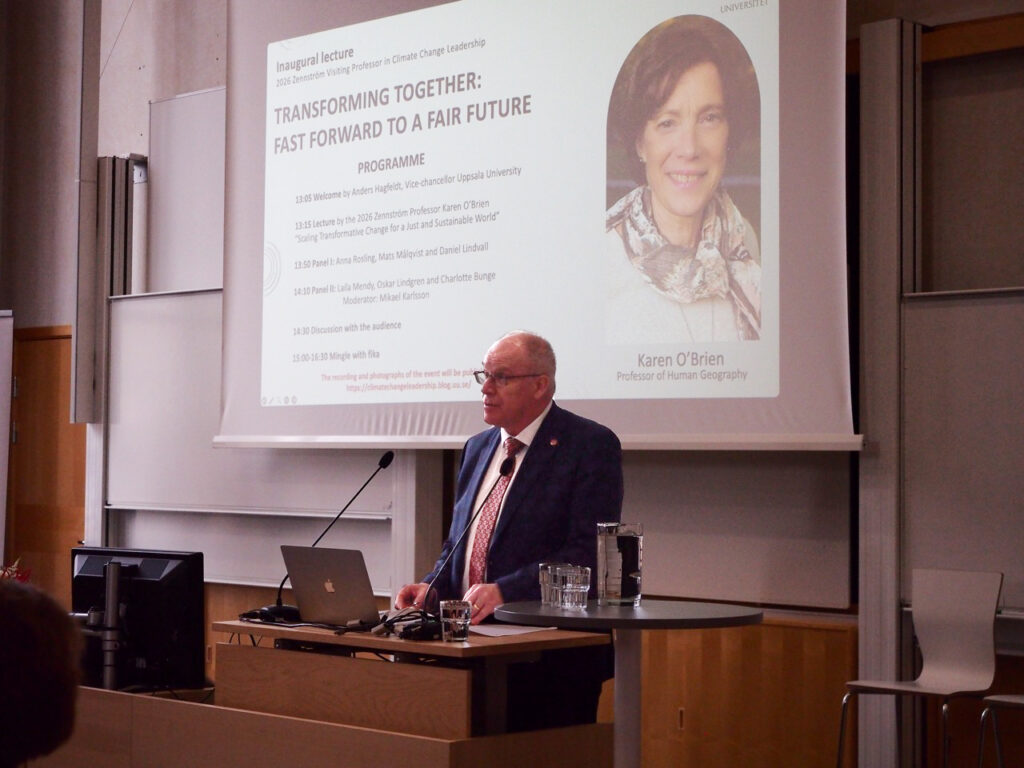
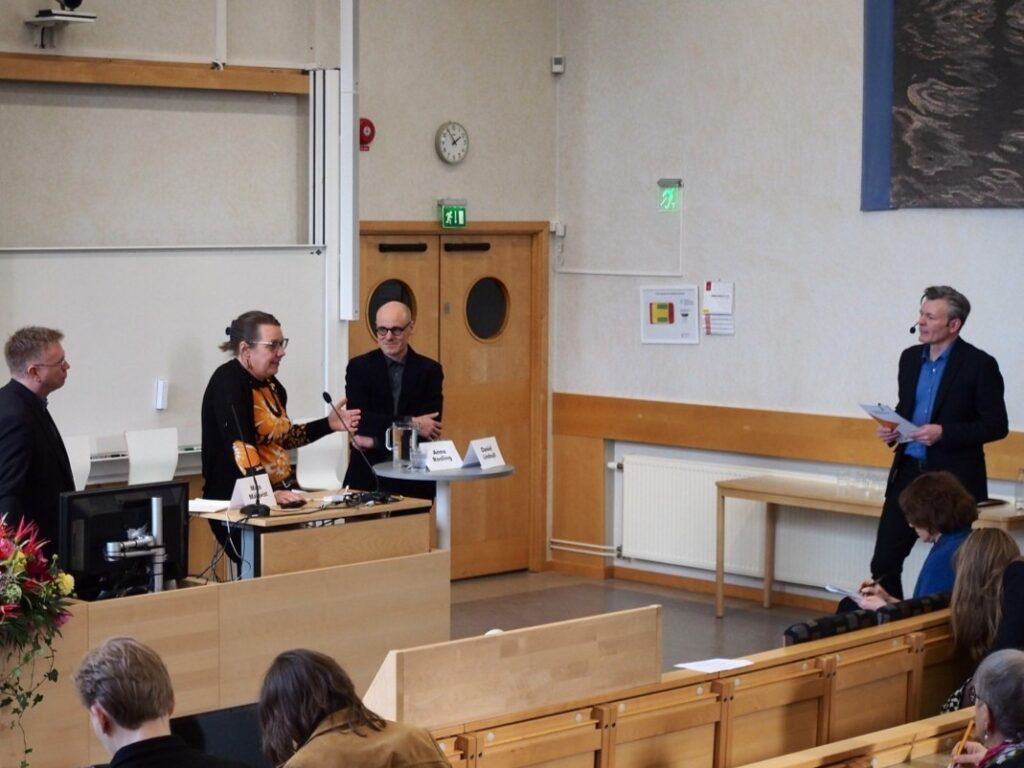
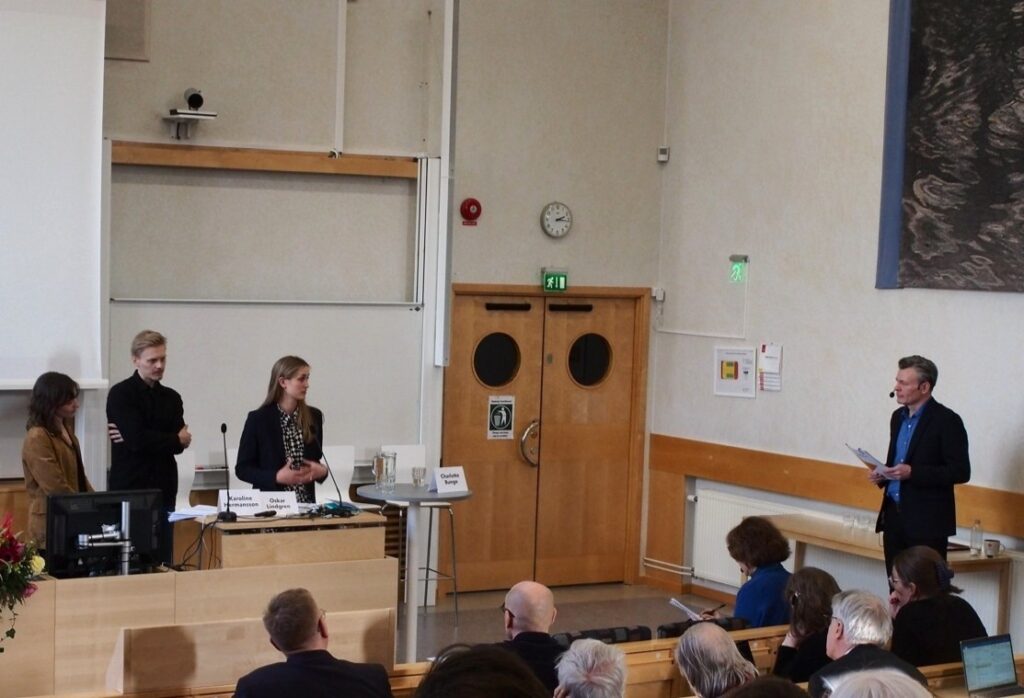
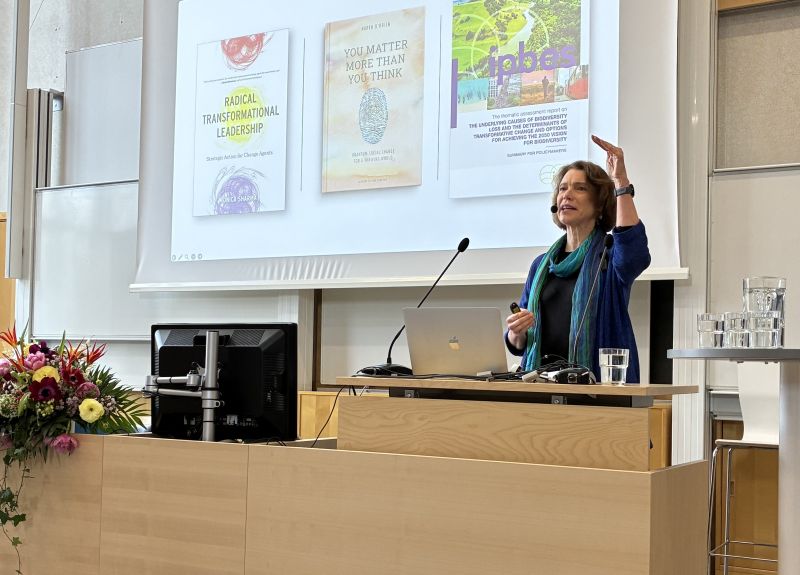
Karen O’Brien, the new Zennström Visiting Professor in Climate Change Leadership, delivered her inaugural lecture at Geocentrum, Uppsala University, on 16 March 2026. O’Brien, co-founder of cCHANGE and Professor Emerita of human geography at University of Oslo, led the audience through an inspiring account of her personal and professional journey, showing how the two have informed one another and shaped her approach to climate transformations. She brought a hopeful vision on how to bridge theory and practice for change. Her lecture, titled Scaling Transformative Change for a Just and Sustainable World, was followed by two panel discussions, moderated by Associate Professor Mikael Karlsson. The panel discussions featured both senior and early‑career researchers from Uppsala University and opened up engaging conversations that we hope will continue during O’Brien’s visiting professorship. 

Below is a summary of the lecture. The full event recording is available at the end of this blogpost.
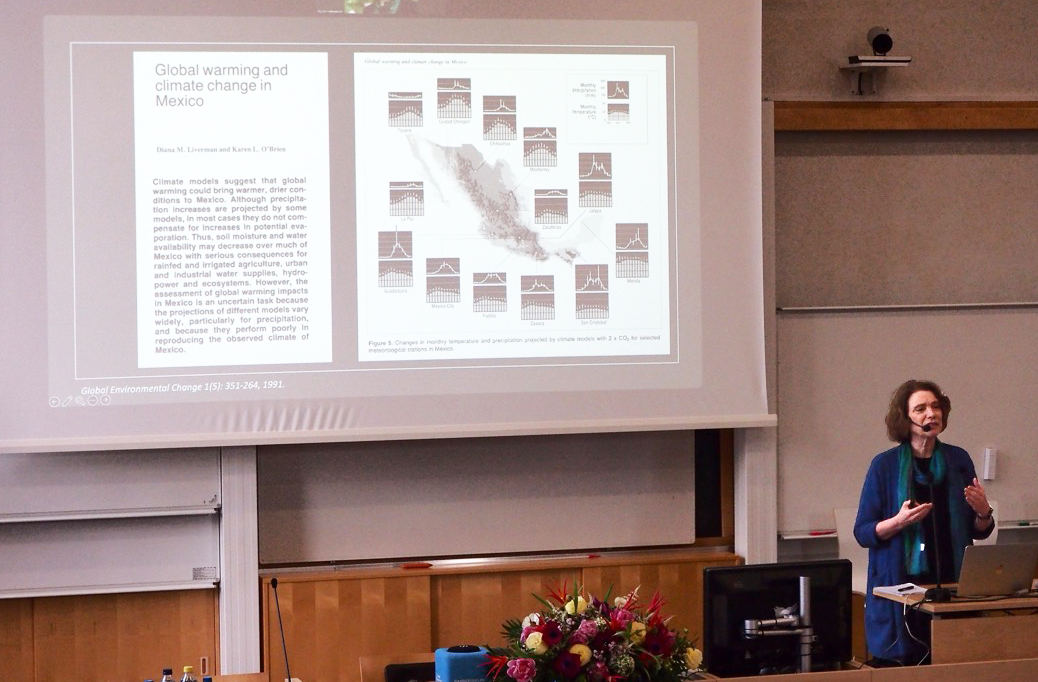
Karen O’Brien during her lecture. Photo by Judith Lundberg-Felten

Opening the event, Vice-Chancellor Anders Hagfeldt underscored that climate change remains a non‑negotiable global threat despite shifting political tides and geopolitical uncertainties. Photo by Emma Löfgren

Scaling Transformative Change for a Just and Sustainable World

“How do we rapidly scale transformative change for a just and sustainable world? And how do we do this in an ethical and equitable manner? For me this means looking at the relationship between individual change, collective change and systems change. Why we – all of us – matter when it comes to this change.”

Karen O’Brien in her inaugural lecture

Photo by Emma Löfgren

Climate Research and the Question of Scale

From the beginning of O’Brien’s career, when she studied the impacts of climate change in Mexico, scale has been a continuous theme running through her research. Early on, she noticed the disconnect between the large scale and the small scale in climate science, including how local deforestation interacts with global climate change. This drew her toward examining the relationships between human and natural systems in the Chiapas region, showing how deforestation and local social struggles were closely intertwined.

Resilience, Globalization and Double Exposure

Later on, when O’Brien’s personal life brought her to Norway, she suddenly found herself in a country often described as highly resilient to climate change, and in some ways even a net beneficiary, with milder weather and longer agricultural seasons. This raised a central question for her: Is Norway actually resilient to climate change? As she argued, the answer depends entirely on scale, where you are, what you do, and which systems support your wellbeing and way of life. From a global perspective, Norway is considered relatively resilient compared to other countries, yet this perceived adaptability can easily slip into a dangerous complacency, and risks missing sight of the uneven distribution of benefits and risk, in Norway and beyond. Again, the question of scale was central.

It was during this period that O’Brien began to focus more closely on the differentiated social capacity to adapt to climate change, and tying the effects of climate change together with economic globalization. Bringing these two trends together, she showed together with Robin M. Leichenko how their combined effects systemically create distinct Winners and Losers in the Context of Global Change. What emerged from this work was a recognition that these vulnerabilities are not accidental but systemic, shaped by where people are positioned within broader social, economic, political, and environmental systems and how global trends are interlinked.

From Adaptation to Transformation 

O’Brien stressed that climate change is not a technical problem but an adaptive challenge – one that requires us to think, behave, and act differently. Our responses are shaped by our values, worldviews, and underlying paradigms, which influence how we understand climate change, how we choose to address it, and what actions we see as possible at different scales. Because human activity is altering global systems, she argued, it also means we have the capacity to change them deliberately.

The most significant form of adaptation, then, is transformation: recognizing that we are capable of changing large-scale systems like the climate, and that we can therefore intentionally transform the economic, social, and political systems that drive those changes. She describes this as adaptation as deliberate transformation to sustainability, something reflected, for example, in her recent book You Matter More Than You Think and in the IPBES Transformative Change Assessment, which she co-led.

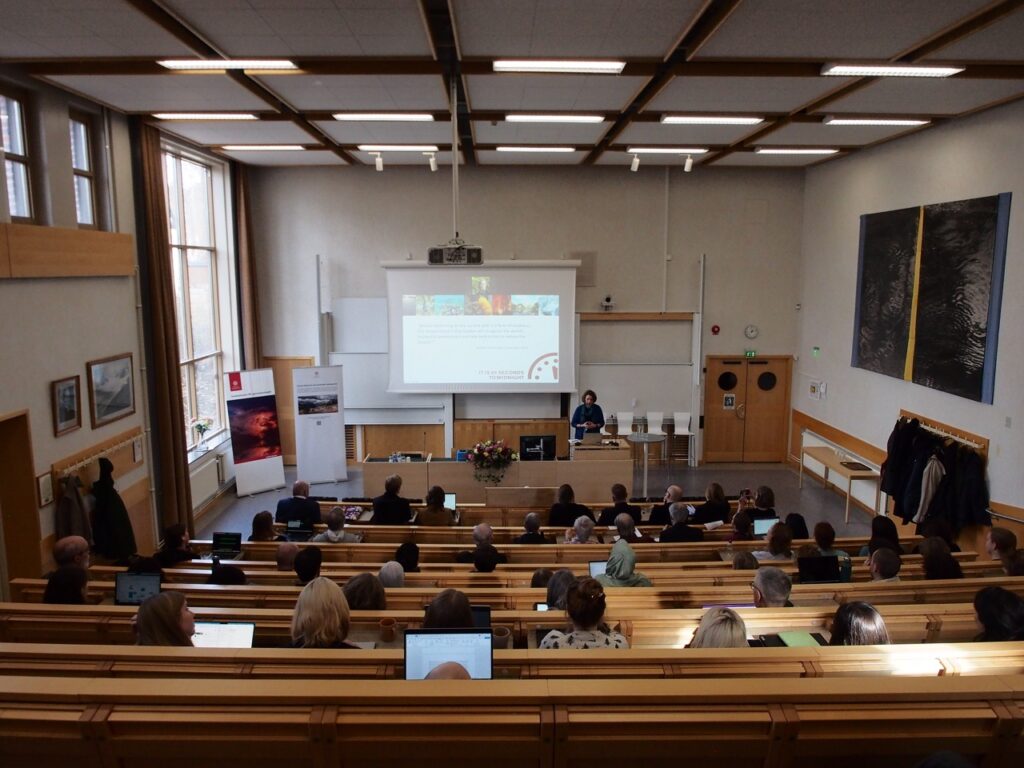
The inaugural lecture took place at Hambergsalen, Geocentrum. Photo by Emma Löfgren

Fractal Change, Agency and the Three Spheres 

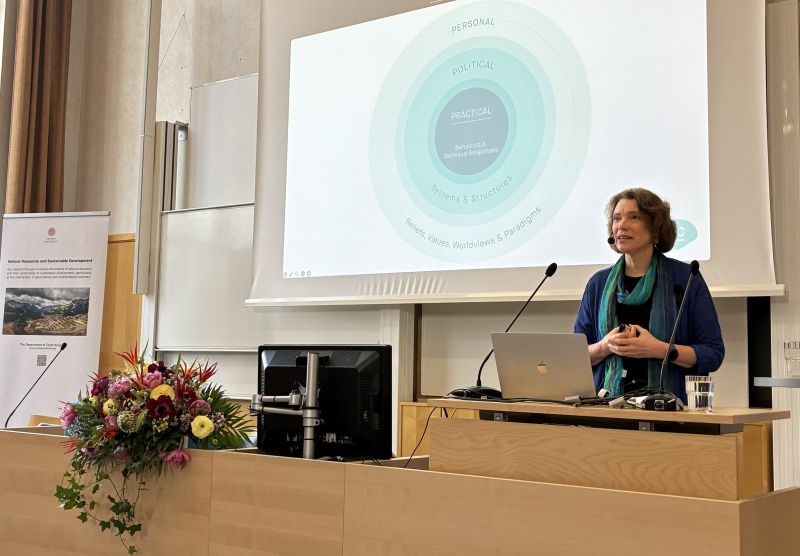
O’Brien closed her lecture with the idea of fractal transformation and the need to connect the practical, political, and personal spheres of change. Practical actions, behaviours and technical responses, such as installing solar panels or setting sustainability goals, are of course important, but they remain insufficient without corresponding shifts in the political sphere, where systems, institutions, norms, and incentives are shaped and contested. At the same time, the personal sphere, our beliefs, values, worldviews, and paradigms, is often overlooked, even though it deeply influences how individuals perceive systems and exercise agency within them. When these spheres – and scales – are treated separately, we end up with fragmented responses to interconnected challenges.

Instead, O’Brien proposed a fractal approach rooted in universal values such as dignity, equity, fairness, and integrity, values that can guide action across all scales. People must be understood as subjects of change, not objects to be changed, and we need to stop underestimating our collective capacity for transformation. Even small shifts matter: it is often said that around 10% of a population can tip social norms. Through quantum social change, fractal agency, and value‑driven action, she argued, fair and non‑linear transformations toward sustainability are possible. 

O’Brien will continue her research and other activities on this approach while at Uppsala University until February 2027.

Photo by Judith Lundberg-Felten

Senior researchers panel with Mats Målqvist, Anna Rosling, and Daniel Lindvall, moderated by Mikael Karlsson, from left to right. Photo by Emma Löfgren

Junior researchers panel with Karoline Hermansson, Oskar Lindgren and Charlotte Bunge, moderated by Mikael Karlsson, from left to right. Photo by Emma Löfgren

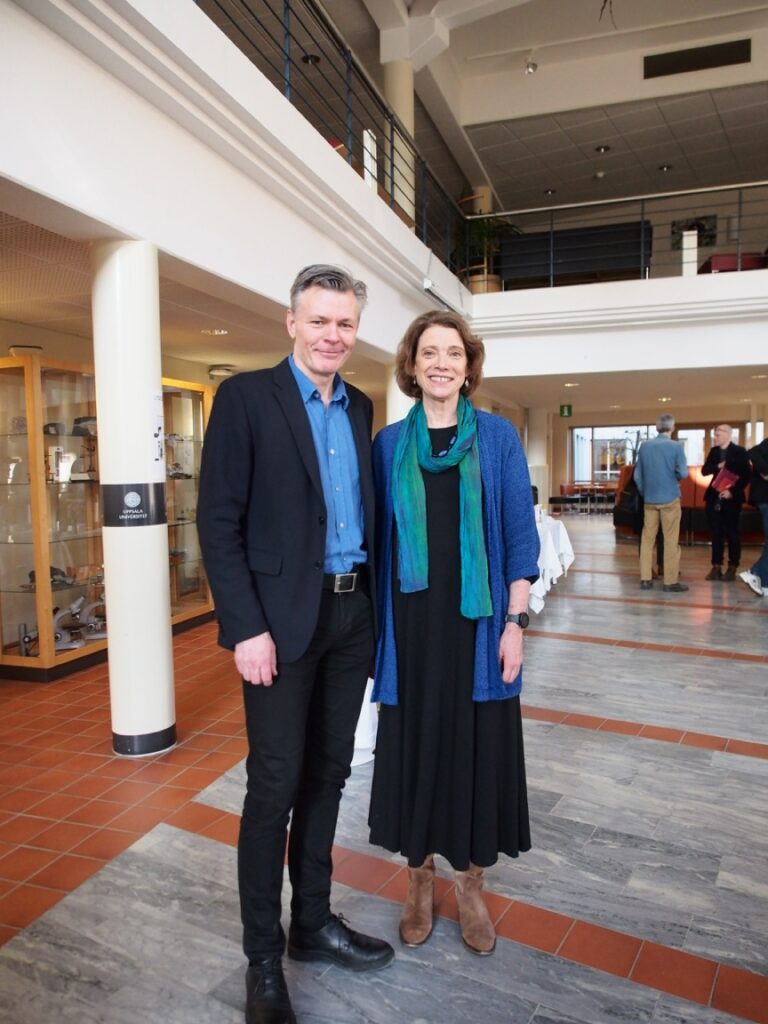
Mikael Karlsson and Karen O’Brien, from left to right. Photo by Emma Löfgren

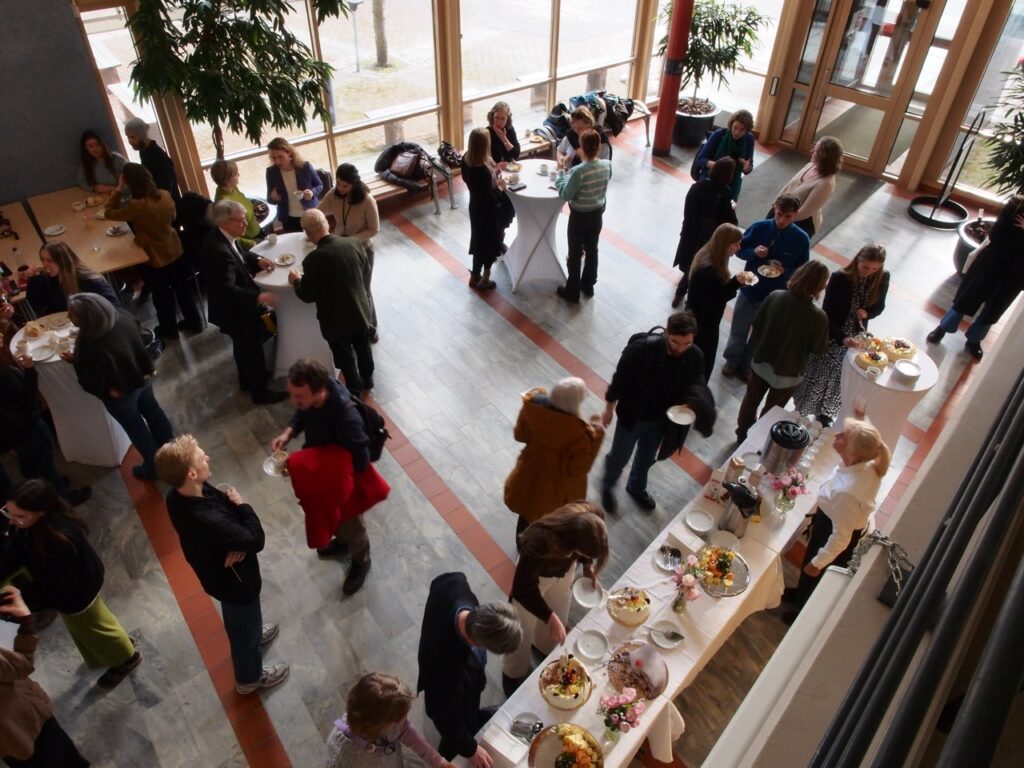
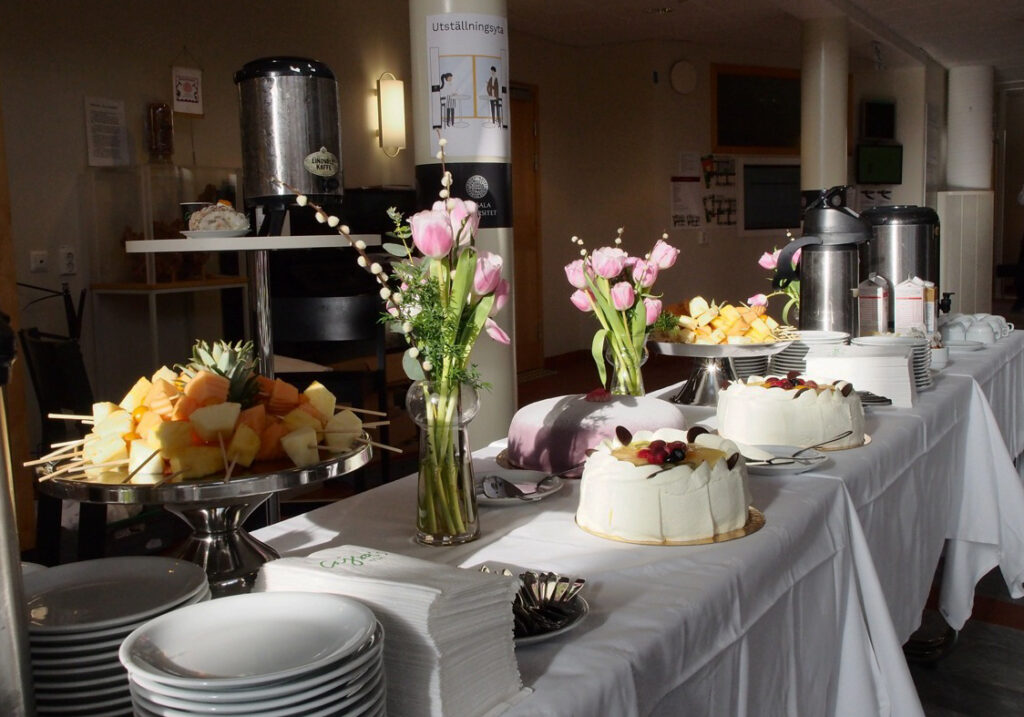
Mingle with cake and coffee after the lecture. Photo by Emma Löfgren

Photo by Emma Löfgren

Thank you to Jayne Glass for her great suggestions on the text in this blogpost.